Showing posts with label Hartt history. Show all posts

Sunday, December 3, 2017

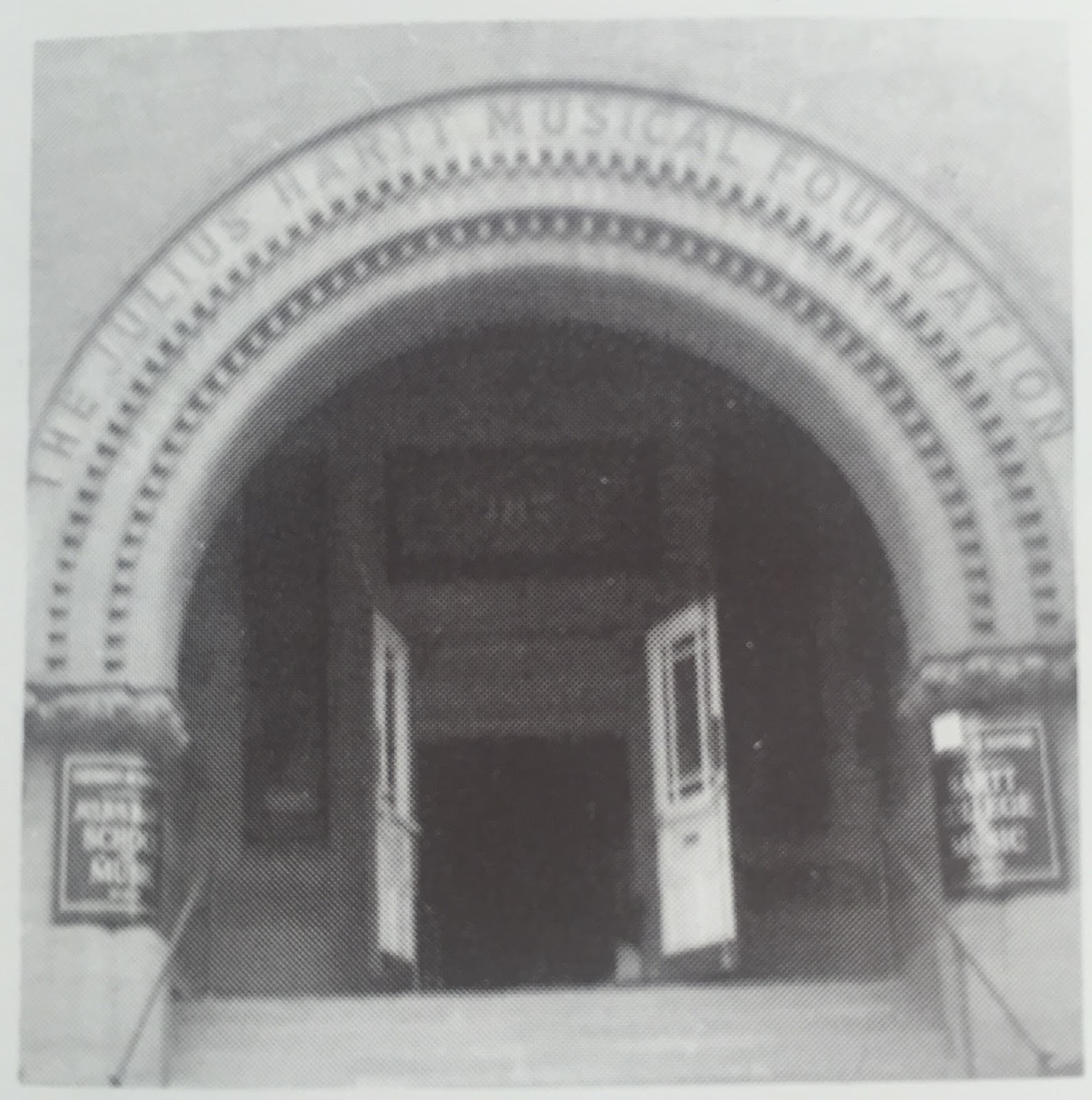
Original School Brochure 1920-21

1920 - World War I had ended.  Jazz was just emerging.  Warren G. Harding was elected President of the United States.  Prohibition began.  Women attained the right to vote.  Mass media was born with a license given to the first commercial radio station.  America was about to start Roaring. 


And, The Hartt School was officially formed.  1920 is the founding date of our school and, thanks to the University of Hartford archives and Prof. Dee Hansen (leading the committee planning Hartt's centennial celebrations), below is the original brochure for the school.


Contained in these several pages is the philosophy on which our founders built their legacy.  The prose is elevated and contained within are a few surprises.


How many of us had heard of "Boris" Paranov?  Most of know Morris Perlmutter changed his named for professional reasons to Moshe Paranov, but I had never know that Uncle Moshe once went by Boris.  Ernest Bloch as a faculty member.


Citation - Julius Hartt Musical Foundation, Inc. records (ARCH161). University of Hartford Archives and Special Collections.


Wednesday, August 30, 2017

March 1964 issue of International Musician, cover article re Moshe Paranov and Hartt

The March 1964 edition of International Musician, published by the American Federal of Musicians, featured an article about Moshe Paranov and the new Hartt building - the Fuller Building.  Moshe and a photo of the building appeared on the cover.  There are lots of interesting things in this article, including the fact that the original building cost a total of $2.6m to build.

Check out Uncle Moshe's quote about his decision to not strike out for Europe or other major metropolitan center early in his career as was the typical path.

"I hope that I have demonstrated that it is possible for a student of music to become a musician by the unorthodox method which I selected.  Less of glamour, yes; more of heartache, decidedly; but great satisfaction, definitely."

I also like the 1964 advertisements.

As we move toward the completion of the renovation of Millard Auditorium, it is amazing to think about the original dedication concert, with performances by Marian Anderson, Isaac Stern and Leonard Rose.  I would have liked to be in attendance!

Special thanks to Seth Bogdanove, Uncle Moshe's nephew who used to vacation with the Paranov family in Maine.  Seth saved this article and sent me the digital copy. 

(By the way - If anyone is in need of photo restoration and digital archiving skills, please reach out to Seth at Digital Archiving and Photo Restoration by Bogframe, 17 Bay 31st Street, Apt 2, Brooklyn, NY 11214, (718) 373-7575, www.bogframe.com).


Wednesday, November 9, 2016

Hartt History: 1936 - 1955

1936 - Julius Hartt retires as director of The Hartford Musical Foundation and the name of the foundation is changed to The Julius Hartt Musical Foundation in his honor.


1937 - Alfred C. Fuller becomes a member of the Board of Trustees.
1938 - The Board purchases 187 Broad Street in Hartford from the Hartford Seminary.  Dedication exercises are held and feature Harold Bauer, one of the world's greatest pianists, with the Hartt School Chorus and Orchestra.  Samuel Berkman is appointed Dean of the Julius Hartt School of Music.
Moshe Paranov is appointed Music Director at WTIC.

1939 - Irene Kahn, accomplished ensemble player and accompanist, joins Moshe Paranov in the first of many highly acclaimed duo-piano recitals at the new Broad Street location.
1940 - By vote of the Connecticut State Board of Education, Hartt becomes the first independent institution in the state with the right to confer the Bachelor of Music degree.


Alfred Einstein, preeminent German musicologist and critic, joins the Hartt faculty.
1942 - Dr. Elemer Nagy joins the Hartt faculty.  The first Hartt opera production, a double bill, is presented.  The program features the first American performance of Franz von Suppe's Ten Maidens and No Man, Moshe Paranov conducting, and the first Hartford performance of Paul Hindemith's Here and There, with Hindemith conducting.

Wednesday, August 24, 2016

Hartt History: 1895 - 1935

1895 - Morris Perlmutter is born on Pequot Street, Hartford, CT.


1909 - Julius Hartt moves to Hartford from Boston and assumes the position of organist at Asylum Hill Congregational Church.

Morris Perlmutter begins work as a pianist in theatres and hotels in Hartford and, later that year, becomes the conductor of the Good Will Club Orchestra whose artistic advisor is Julius Hartt.


1912 - Morris Perlmutter debuts at Hartford's Unity Hall on Pratt Street in a performance of Beethoven's G Major Piano Sonata.


1914 - Julius Hartt becomes Music Editor for the Hartford Times.

Thursday, July 7, 2016

Director's Message from 1952 Still Resonates

To recognize the 100th blog post, here are two pages from the Hartt's 1952 Allegro Yearbook.


Moshe Paranov, circa 1952

I was not around in those years, but I gather that there was a yearbook published each school year.  This was the Director's Message from Moshe Paranov.  The message is equally valid today.


Sunday, April 3, 2016

Former Hartt Professor, Bernard Lurie, Passes Away

The Hartt family mourns the passing of long-time professor, Bernie Lurie, and extends condolences to his family.


Bernard Lurie, retired Concertmaster of the Hartford Symphony, CT Opera and Hartford Ballet passed away peacefully on March 31, 2016 at the age of 82. Bernie was born in Philadelphia on June 20,1933 to Bertha and Morris Lurie and was the loving brother of Ruth Lurie Snyder. Bernie was also a retired Professor of Violin, Viola, Ensemble, Conducting and Orchestra Studies at the Hartt School of Music at the University of Hartford. For 25 years he conducted the Greater Hartford Youth Orchestra (GHYO) with concert tours of Romania (1973), Switzerland (1976), England, Ireland and Scotland (1979), Italy (1983) and China (1987). He also founded the orchestra at the University of Massachusetts at Amherst.


Bernie studied violin under world renowned pedagogue Raphael Bronstein who brought him to New York and then to the Hartt School where he earned both his Bachelor's and Master's degrees. He was the recipient of several scholarships and fellowships including those awarded by Tanglewood and Hartt. Bernie was a former member of orchestras in Philadelphia, New Jersey and New England, and served many as Concertmaster including the Brattleboro Music Festival, Hartford Music Festival, New Haven Symphony "Concerts on the Green," as well as symphonies in Bristol, New Britain, Waterbury, Meridan, CT. He performed under the batons of such conductors as Leonard Bernstein, Aram Khachaturian, Charles Munch, Lorin Maazel, Jorge Mester, Arthur Winograd as well as Arthur Fiedler and Lucas Foss. His former students continue to perform in major symphony orchestras and chamber groups around the world.


Bernie was a beloved husband of Sheila Lurie, loving father to Elena Lurie Meinhardt and Stephen Lurie, loving Poppy to Jillian and Garrett Meinhardt and Jadyn Rose Lurie. Funeral services will be held on Sunday, April 3 at 11am at Bernheim-Apter-Kreitzman Suburban Funeral Chapel, 68 Old Short Hills Road, Livingston, NJ 07039 with internment following at B'nai Abraham Memorial Park in Union, NJ.


In lieu of flowers, the family asks that donations be made in memory of Bernie to the Crohn's & Colitis Foundation, Citizens United for Research in Epilepsy or Temple B'nai Abraham. The family wishes to give special thanks to Dr. Eilon Krok and the staff at Saint Barnabas Hospital in Livingston, NJ.       


http://www.legacy.com/obituaries/hartfordcourant/obituary.aspx?n=bernard-lurie&pid=179490730&fhid=12152

Wednesday, March 30, 2016

Sunday, May 3, 2015

The Gress-Miles Organ Finale

Here are a few photos from last night's Organ Finale.  Organ alumni spanning 6 decades gathered for a final concert on the Gress-Miles instrument.

Picture taken for the dedication.

Just before the May 2, 2015 Finale celebration.

Friday, May 1, 2015

Julius Hartt's "Letter to a Young Musician"

Nearly 100 years later, this letter is still rings true.  Originally published in 1918 in the Hartford Times newspaper it is the fifth in a series of six articles under the title "Letter from a Musician."

The great composer, Ernest Bloch, who after 36 years in America referred to Julius Hartt (1869-1942) as a brother, stated that this letter is "by far the best writing I have read on the subject."  Mr. Bloch was said to have carried the article in his pocket for years and introduced the set of articles to his students.

Find a quiet space and some time and let the beauty of the writing wash over you and the content sink deep.


Julius S. Hartt


Dear confrere: I have no other warrant for thus addressing you than the interest in your artistic and material welfare which and right-minded musician of mature years might be assumed to feel for a younger comrade. The impulse to write you in this intimate and unconventional way came to me the other day under circumstances of which I should like to tell you in some detail. The occasion was a late afternoon musical; the place a spacious and beautiful gothic chamber rich with the evidence of generous mean and perfect taste.  The composer whose spirit and voice settled down on this twilight hour was Johannes Brahms; the music brought forward was this master’s two rarely heard and lovely sextets for strings, Opus 18 and Opus 36. The performers were Mary Mukle, artist through and through and most accomplished of women cellists; Pablo Casals, artists., musicians, virtuoso of virtuosi; David Mannes, one of the most distinguished of contemporary violinists; and three players less well known, but artists every one – Reber Johnson played the second violin, and Rebecca Clarke and Giulio O. Harnisch the violas. The audience that quietly stole into the shadows of that great room included artists known world over, as well as humbler folk.  All alike were drawn thither by the call of art for art’s sake. For the beautiful thing about all this, my friend, was the spirit of the occasion. And the spirit of the audience no less than of the performers, really was the spirit of art for art’s sake. These great souled artist performers gave themselves over to the joy of noble music for sheer love of it; and their happiness they shared with their friends. That was all. But it was no impromptu undertaking. There had been much painstaking and careful preparation. It was my privilege to be present at the final rehearsal.  And please believe me, if the rank and file of lesser performers, whether as individuals, or groups of larger or smaller dimensions, were to bring to the preparation of their public musical undertakings half the loving care and scrupulous thoroughness with which these great artists made ready for a purely private appearance before their friends, the world over would be spared a vast amount of slovenly and impossible music. I wish you could have heard Casals’ frequent though gentle insistence upon repetition after repetition of delicate and exacting passages. I wish you could have witnesses Mannes’ affection defer to “Pablo,” and Casals’ generous rejoinders to “David.”  The spirit of it all was so beautiful. So unlike the deadening and deadly professionalism that cuts the soul out of art; it was all so like the music – as truly the essence of the music as the perfume is the essence of the flower. And when the next day I sat listening in that twilight hour to music as truly gothic in spirit as was that shadowy room or any venerable cathedral (music pointing finger-like towers of aspiration toward heaven) I gave myself up not only to dreamy realization of exquisite music but to half conscious musings upon the things that men live for and that we musicians strive for.

In the presence of the slow movements of those celestial born sextets, how tawdry, how coarse, how cheap, seemed the possession of mere things, how trifling fame, money, power, position. In the scherzos how vibrantly pulsated the joy that is the normal birthright of every human being whose deathless inner life is free under God’s jewelled [sic] heaven. In the allegros what horizonless expanses of imagination; what serene and all-reconciling outlook over the great world of humanity throbbing, surging with passion and pain, love and hate, hope and despair, joy and sorrow, plenty and want, ugliness and beauty, sickness and health, childhood and old age, death and decay, time and eternity! And yet what unity; what symmetry; what masterly adjustment of means to ends; what perfection of form; what balance of heart and brain! (Albeit Brahms’ scales incline toward the intellectual.) And, because it is great and true art, how surely this music pertains to the real life of Brahms; not less surely than that all true art is an expression of the inner life of its creator – God’s life. For every creative life is a spark of the great Creator’s life. Brahms’ personal history was simple and uneventful. He traveled comparatively little and gravely avoided the public gaze. His life was one of contemplation. He lived in an atmosphere of reality – God’s reality; reality of spirit, the reality of nature. And the incidentals which most men with gross and perverted vision mistake for essentials, and worship as ancient Israel worshipped [sic] the golden calf, Brahms looked upon as incidentals; and with austere disdain refused to be beguiled by the lure of mammon. He was devoted to the ideals of beauty. But he knew that beauty is a relative term. He knew that beauty implies ugliness; and he instinctively felt that as art must mirror life and nature it therefore must disclose beauty not as a universal element but as the sublime antithesis and conqueror of ugliness. And thus it is that the music of Brahms rings true to life. And thus it was that the noble Brahms Sextets came as a message of truth and beauty to the listeners in that darkening room on the occasion of which I am speaking.

You are wondering why I am writing you all this. Young musicians often seem to think of music as a professional garment, a sort of uniform that identifies the wearer as a member of a distinctive aesthetic cult. They do not very generally seem to realize that music is a life to be lived. True artistry is a creed; it is a religion. It is not primarily as most young musicians imagine, and many older musicians seem to believe, a means of livelihood. Artistry does not consist in the ability to perform creditably a larger or smaller amount of fine music. It does not consist in reputation.  Large fees bear no necessary relationship to it. Success, as the world views success, is not its symbol. Again I say, my friend, art is a life; it is a kind of living. And it is a kind of life and a kind of living far from the popular or fashionable among music’s nominal devotees. Again I say art is a creed; it is a religion. It is a creed and a religion that like all creeds and all religions that ennoble men and uplift humanity rests deep in the inexorable and eternal principle of the cross. Whatever the complexion of your religious thoughts or mine, please do not assume that I am using the word cross in any theological sense. I mean simply that the true artist’s life must conform to the principle of the cross. I mean that the true artist’s creed begins with self denial. I mean that the artist’s salvation hinges upon self forgetfulness. I would wish that every young musician like yourself would come early to realize that control and subjugation of self, in a hundred thousand ways, is the real technic to be acquired – the technic of right living. Now at the threshold of your career I wish that you could clearly see that no artist’s art is greater than his life. I wish that this great truth might sink deep into your inner consciousness – that art is life. Believe me what you play at your instrument is not only the music of your composer, but it is yourself. Your art is not a professional garment – it is you. If your soul is little soul, if your life is a little life, then your art is a little art, and you are a little artist. If your ideals rise no higher than your own personal concerns, your own advancement, your own success, your own glory, then you are a heretic to the only real creed of artistry; and whatever devices of concealment you may cultivate, your heresy will be branded large upon the thing you call art. And all real artists and all clear visioned lovers of art will see your shame. 

I have known musicians, young and old, whose everlasting inquiry centered in money. I have heard of musicians, or would-be musicians who could never be sufficiently interested in the very thing they professed to love, to live in close communion with it an hour or two a week without promise of financial reward. Think of that, will you! And then tell me if a lunatic could imagine anything more fantastic than such cheap musical jockeys posing musicians or as artists. So you think that a spirit like that pertains to real artistry? I say no. And it is at this point that I would like to make application of the little story of the twilight musical. It is the moral to be deduced from that musical that I would like this letter to suggest.  Several of the artists who played those Brahms Sextets on that February afternoon have world-wide reputations. They command the largest fees.  They stand unchallenged as consummate artists.  Their activities are many and important.  And yet here they were with their friends quietly communing with Brahms. There were no money considerations. There was but one motive, and that motive “art for art’s sake.” That was like the music they were playing too. That was like Brahms. And that was like, and is like, world without end, all true art, and all true artists.

The moral is plain.

Julius Hartt - Dated 2 March 1918 for the Hartford Times

Sunday, August 17, 2014

Moshe Paranov on the Competence of Teachers


The following is an excerpt from an online publication called “The Rhythm of Successful Teaching,” by Hartt alumnus Larry D. Allen.

Mr. Allen was Principal of Boone Grove Middle School in Boone Grove, Indiana. He also taught and conducted at the college and university level at Trinity College (Hartford, Connecticut), The Hartt School, Central Connecticut State University, Valparaiso University, VanderCook College of Music, Duquesne University, and Villanova University.  Among his degrees, Mr. Allen earned a Masters of Music Degree in oboe performance with Bert Lucarelli at the Hartt.

In this section of his publication, called Competence and Incompetence, Mr. Allen relays some stories about Moshe Paranov and his philosophy of teaching music.

Competence and Incompetence

One of the mysteries about teaching in public schools is that almost all of our gurus and geniuses throughout history that daily receive universal respect and admiration would not legally qualify to be our child's teacher.
Moshe Paranov

Moshe Paranov was a musical guru who provided outstanding leadership at the Hartt School throughout most of the 20th century. He and his team of outstanding teachers developed an idea: to build an outstanding school of music in the greater Hartford, Connecticut area to international acclaim and respect. Moshe’s official title was Dr. Moshe Paranov, President of the Hartt School of Music of the University of Hartford. All the children knew him as “Uncle” Moshe. He was active into his 90’s as the Artist-in-Residence for the schools in Glastonbury, Simsbury, and Torrington, Connecticut. Imagine being in demand as a teacher at 90 years young.

The reality of Dr. Paranov’s talent began to unfold in his high school years, as he entered the principal’s office one morning requesting that the principal give him permission to attend school daily for the balance of his high school year beginning at 10:30 a.m. so that he would have time to practice the piano at home from 6:00 a.m. to 10:00 a.m. With little hesitation the principal presented Dr. Paranov with the bad news regarding the request even though there was strong parental support.

With that decision, Dr. Paranov moved on with his life, left school and proceeded to practice four hours per day from 6:00 a.m. to 10:00 a.m., and over the years became a legend without his high school diploma. He built one of the most respected music schools in the world, and he received an Honorary Doctorate from the Philadelphia Music Academy.

Over the years Dr. Paranov interviewed hundreds of candidates to teach in his highly respected school. His mantra was, “play first and then we will talk.” If the candidate played well, the hiring took place immediately. If the candidate could not play well, there was no talking just a painful silence that communicated the message.

Each year there was an opening meeting at the Hartt School of Music where all the faculty would return after a hearty summer of touring, recording, and many exciting musical performances. Dr. Paranov would command the open meeting with humor, enthusiasm, and commitment. The opening speech went like this each year:

I want to welcome you all back to another season of excellence. What I want from each of you teachers is to know “what have you done today to help each of your students and what have you done today to make yourself a more competent musician and a more competent teacher.”


Saturday, February 15, 2014

Hartt Guitar Department - 50th Anniversary Celebration

The following post is copied from the Alumni Newsletter of The Hartt School's Guitar Department.  I am re-posting it here to further encourage everyone to attend the 50th Anniversary Celebration of the Guitar Department.
 
**************
Fiftieth Anniversary Celebration

Hello all,

Plans are moving surprisingly smoothly for our fiftieth anniversary celebration. Thanks to grants from the Augustine Foundation and LaBella Strings as well as contributions by several of our alumni we are $1000. away from raising the necessary $14,500. needed to underwrite the cost of Andrew York’s concert and the commissioning of Frank Wallace’s incredible eight-part work, As it Could Be, for the celebration. I’m hoping that many of you will be able to contribute to the fund so that we can reach our goal. No gift is too small or too large. If you are so inclined, please make the check payable to the University of Hartford and send it to me % The Hartt School, 200 Bloomfield Ave., W. Hartford, CT 06117. I would like to be able to say that all of the money raised came from Foundations or alumni.

 What do we have planned?

 Friday, April 11: 7:30 Auerbach Auditorium:  Solo Recital by Andy York.

 We begin the celebration with a concert by Andy York.  Andy has been a friend of the department for many years and has graciously altered his fee to meet our limited resources. After the concert, we will hang out at the Republic, our new hangout just one mile from the University.

 Saturday, April 12:

Saturday we have a full schedule of events. All events are in Millard
     9:00 AM -11:00AM Open rehearsals At this point we are not sure what groups performing that evening will be rehearsing.
     11:30-12:30: Suzuki guitar presentation. Nick Cutroneo
     12:30-1:30:  John LaBarbara. New music for guitar
1:30- Break
      2:00 -5:00: Rehearsal for Attic by Andrew York alumni, students, faculty community. This will be the concluding work
     on this evening’s program
 5:00- 7:30: Dinner Break: If enough people are interested, the Republic will make the restaurant available to us for dinner.

 8:00 PM: Anniversary Concert: World Premiere of Frank Wallace’s As It Could Be, made possible by a grant from the 
Augustine Foundation.
1) Changes Upon the Guitar, violin, viola and seven guitars
2) A Tune Beyond Us, violin, viola and guitar
3) A Wisp in the Underground, guitar solo    
4) If to Serenade, flute and guitar
5) Tom-tom, c'est moi, percussion and guitar
6) The Whirling Noise, viola and guitar   
7) Crying Among the Clouds, guitar solo
8) A World Quite Round, guitar quartet

NOTES

These eight works comprise As It Could Bea chamber suite dedicated to the Hartt School of Music Guitar Department and it's founder/director Richard Provost on the occasion of their 50th anniversary.  Dick suggested using The Man with the Blue Guitar by Wallace Stevens (a resident of Hartford, CT) as a source of lyrics for a song. I chose to use this incredible testimony to art as inspiration and have selected titles for all 8 pieces from the poem. Thank you Dick (and all your colleagues) who brought the guitar out of the dark ages and into a brilliant new community of creativity and progress through your courage, hard work and vision. Let us imagine a future as it could be.

The concert will conclude with a performance of Attic, by Andy York performed by students, area guitarists, and alumni of the department.

 If you will be attending and want to play in the guitar orchestra, (which I hope many of you will) please send Chris an email so that we can send you your part. (ladd@hartford.edu.Our goal is to have at least fifty guitarists on stage performing. If you are timid, rest assured that we will have a core group that has rehearsed and will cover all of the parts. They will be happy to help you during the rehearsal to get you comfortable for the performance. For those of you who have not been doing much with the guitar, this work was written for amateurs. There are several pretty basic parts in the work. If you’re still not sure, let Chris know and he will email you a part to see if your are up to the challenge.

Friday, February 14, 2014

Hartt's Honorary Degrees Given in the 2000s

Between 2003 and 2009, Hartt awarded 5 Honorary Degrees.  The recipients were: Wynton Marsalis; Oscar Ghiglia; William Anthony Waters; Henry W, “Hank” Jones; and Donald Sinta.


*****************************


2003 Wynton Marsalis

I don't think Mr. Marsalis needs an introduction.


Here is a link to Mr. Marsalis' website.


2004 Oscar Ghiglia

Oscar Ghiglia, an Italian classical guitarist, spent time in residence at Hartt.


 Additional information on Mr. Ghiglia can be found on his Wikipedia page.


2005 William Anthony Waters

Maestro Waters was a truly deserved recipient of the honorary degree from Hartt after his many years as a leader in the Connecticut arts community (which is not to say his music career and talents were limited to Connecticut, as he enjoys a career well-beyond the borders of the Nutmeg State).


Additional information about Maestro Waters can be found here.

Wednesday, January 1, 2014

Hartt’s Honorary Degrees Given in the 1990s


In past posts, I have highlighted the honorary degrees awarded by Hartt during the 1950s, 1960s, 1970s, and 1980s.

In the 1990s, Hartt awarded two honorary degrees.  The first was to pianist Grant Johannesen in 1993.

More information about Mr. Johannesen can be found here.

   
The other was awarded to Hartt alumnus (‘51) and composer Jack Elliott in 1997.


This photo was taken of Mr. Elliott during a masterclass at Hartt.  If you are not familiar with Mr. Elliott’s name, you certainly have heard his music.  I encourage you to check out his Wikipedia page here. 

Also, Mrs. Bobbi Elliott donated a significant amount of Mr. Elliott’s materials to Hartt, which now holds The Jack Elliot Collection.  More information about the The Jack Elliott Collection and The Jack Elliott Legacy Project to follow in a later post.

Sunday, December 8, 2013

Hartt's Guitar Department is 50! SAVE THE DATE

SAVE THE DATE!

Fiftieth Anniversary Concert celebrating the founding of the Guitar Department
                               
Saturday, April 12: 8:00 PM, Millard Auditorium

 Did you know?

The Guitar Department at The Hartt School University of Hartford is the oldest performance-based guitar program in the country. Graduating its first member in 1968, 

Friday, October 18, 2013

Hartt's Honorary Degrees Given in the 1980s

Prior to the 1980s, the honorary degrees Hartt awarded focused on professionals in the classical music arena and the benefactors without whose help Hartt would not have been possible.

The 1980s, however, had a different focus.  Jackie McLean started the Department of African American Music in 1980.  Some prominent jazz artists were awarded degrees and even some of the "classical" musicians were clearly within the sphere of the jazz world.  For example, David Amram is difficult to categorize as a classical composer, especially since he has well-known as a jazz french horn player, who appeared regularly with Dizzy Gillespie.  Even Yehudi Menuhin recorded some jazz collaborations.

Nevertheless, here is the next installment of the Hartt Honorary Degree Recipients.

1982 - John Birks "Dizzy" Gillespie


Friday, September 27, 2013

Hartt's Honorary Degrees Given in the 1970s

Continuing the series of entries on the honorary degrees that Hartt has awarded over its illustrious history, here are the honorees from the 1970s.  All links are to wikipedia.

1970     Mary Primrose Fuller


1970     Martha Blake Walcott
 
1971     Isaac Stern


Sunday, September 22, 2013

Hartt's Honorary Degrees Given in the 1960s

Hartt Underwent some significant changes in the 1960s.  Perhaps, most importantly, Hartt moved into the Fuller Center on the campus of The University of Hartford.  Nonetheless, Hartt awarded honorary degrees to the following individuals.  (All links are to wikipedia except where noted.) 


1960     Eileen Farrell